14 Profound AI Alternatives for AI Search Visibility Tracking (2026)
Looking beyond Profound for AI visibility tracking? Here's 14 alternatives — covering pricing, model coverage, data quality, and content tools — to help you find the right fit for your team and budget.
Profound is a well-known name in the AEO space. It was one of the early movers in tracking how brands show up across AI answer engines, and it has some genuinely unique features — real-user prompt volume data, front-end response capture, and an Amazon Rufus shopping module that most competitors still don't offer.
But "early mover" doesn't always mean "best fit."
At $99/mo, the Starter plan only covers ChatGPT. Want Perplexity and Google AIO? That's $399/mo. Want Claude, Gemini, Grok, and the rest? Enterprise pricing, not published. And at Growth, you're still capped at 100 tracked prompts with only 3 user seats.
Depending on what you actually need — broader model coverage at a lower price, content creation tools, deeper data architecture, or a full SEO stack alongside AI tracking — there are alternatives worth considering.
Here are 14 of them.
- Ahrefs Brand Radar
- Scrunch AI
- Semrush AI Visibility Toolkit
- Athena
- Otterly.AI
- Goodie AI
- LLM Pulse
- Peec AI
- Writesonic
- SE Ranking
- Surfer SEO
- AirOps
- Clearscope
- Frase
Let's dig in.
1. Ahrefs Brand Radar
Best for
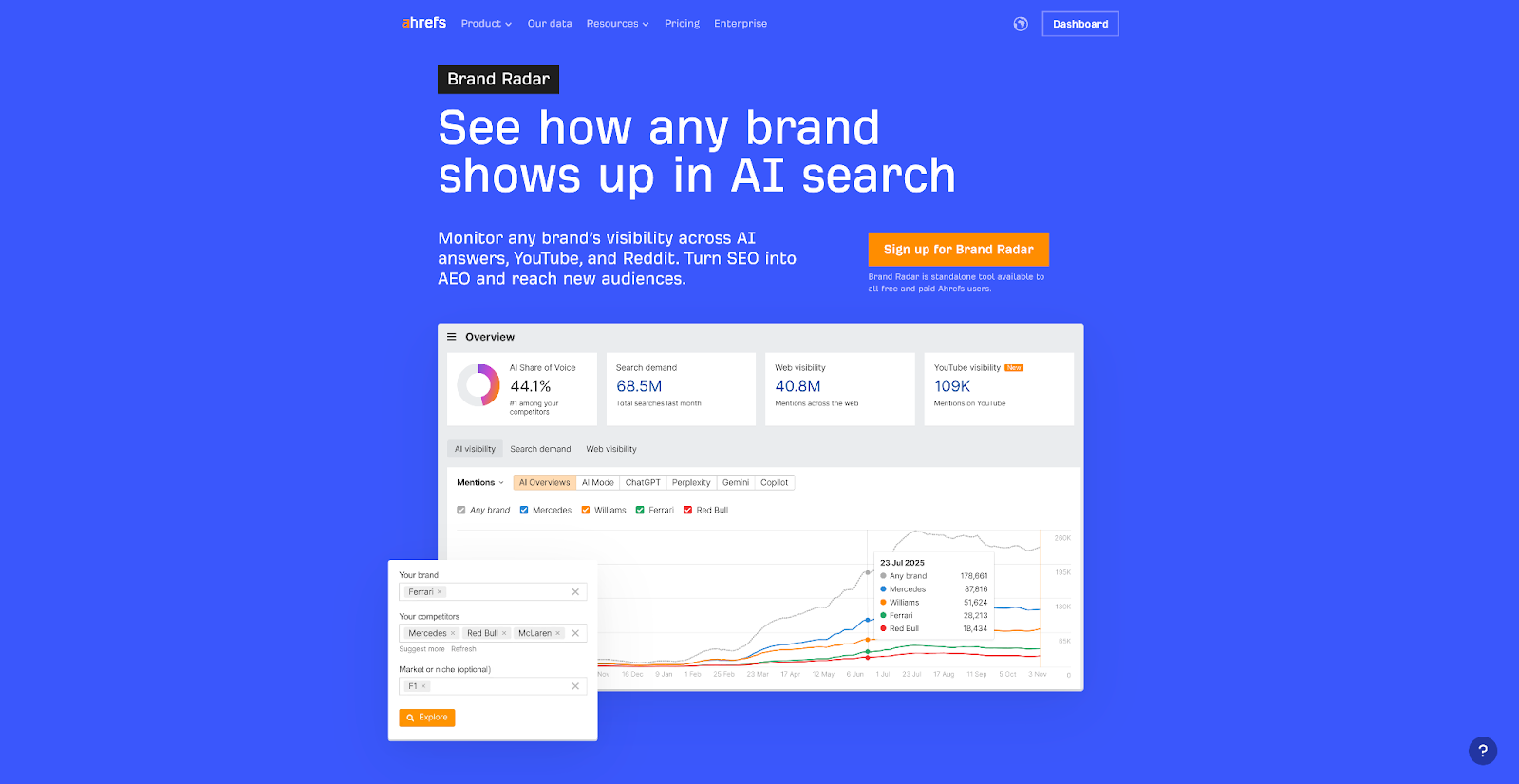
Ahrefs Brand Radar is best for teams that care about data quality over dashboard polish — and want AI visibility anchored in real search behavior. And of course, current Ahrefs users.
Pricing
Free demo tier available. Paid plans: $50/mo (2,500 checks), $100/mo (7,000 checks), $250/mo (25,000 checks), $199/mo per AI index, or $699/mo for all 6 AI indexes + 2,500 custom prompt checks included.
Here's something worth thinking about when evaluating GEO tools: where does the data come from?
The core mechanic behind most AI visibility platforms — Profound included — is the same. Schedule prompts, store responses, build a dashboard. A single developer can build it in weeks. That's why there are over 40 tools in this category and why so many feel interchangeable.
The thing that actually differentiates them isn't features. It's data architecture.
Most tools construct their own queries. They guess what users might ask an AI engine, fabricate those prompts, run them, and report the results. The visibility scores you're seeing reflect how AI responds to questions that may never have been asked by an actual human.
Brand Radar takes the data problem further. Its 243M+ prompts come from real search data — specifically "People Also Ask" questions with measurable search volume behind them. The prompts it tracks aren't hypothetical. They correspond to queries real people typed, which means every metric built on top of that data — visibility scores, mention counts, competitive benchmarks — is anchored in actual behavior rather than simulated scenarios. Learn more about the methodology.
What this means in practice
Brand Radar monitors responses across six AI engines — ChatGPT, Perplexity, Gemini, Copilot, Google AI Overviews, and Google AI Mode — plus YouTube, TikTok, and Reddit. Profound's Growth plan covers three engines. You need Enterprise for ten.
Brand Radar tracks four core metrics: Mentions (how often AI talks about you), Citations (which websites AI links to when discussing your brand), Impressions (exposure weighted by search volume), and AI Share of Voice (your share of the AI conversation in a category).
Where Brand Radar pulls ahead of Profound specifically
The flexible query system. Brand Radar exposes its entire 243M+ prompt database to user-defined queries. You can build filters like:
- "Responses mentioning my brand but citing a competitor's site" (content authority gaps)
- "Queries about [topic] where competitors get cited and I don't" (missed opportunities)
- "All AI responses citing this specific URL" (page-level performance)
Profound delivers structured reports. Brand Radar is closer to a research tool.
Third-party citation mapping. AI platforms frequently cite review sites, YouTube, Reddit, and industry blogs more than a brand's own domain. Brand Radar shows exactly which external sources shape your AI reputation — directly actionable for PR targeting and partnership strategy.
Unrestricted entity analysis. Profound's plans are scoped by seats and prompt counts. Brand Radar lets you analyze any entity — competitor brands, product categories, entire industry segments — without per-entity fees. It operates independently of standard Ahrefs project limits, making it ideal for agencies managing multiple clients.
Search demand history going back to 2015. Plot branded search volume alongside AI visibility over a decade. Rising demand + rising AI Share of Voice = healthy pipeline. Flat demand + rising AI visibility = awareness without conversion. That's the ROI connection executives ask for.
Where Profound still wins
Real-user prompt volume data from consumer panels, and the Shopping module for Amazon Rufus and ChatGPT Shopping. If those are critical to your workflow, Profound covers ground Brand Radar doesn't.
For the full breakdown, check the Brand Radar use cases guide.
2. Scrunch AI
Best for
Brands that want AI visibility monitoring organized around three clear pillars — Monitor, Analyze, Optimize.
Pricing
Core plan at $250/mo. Enterprise is custom. 7-day free trial available.
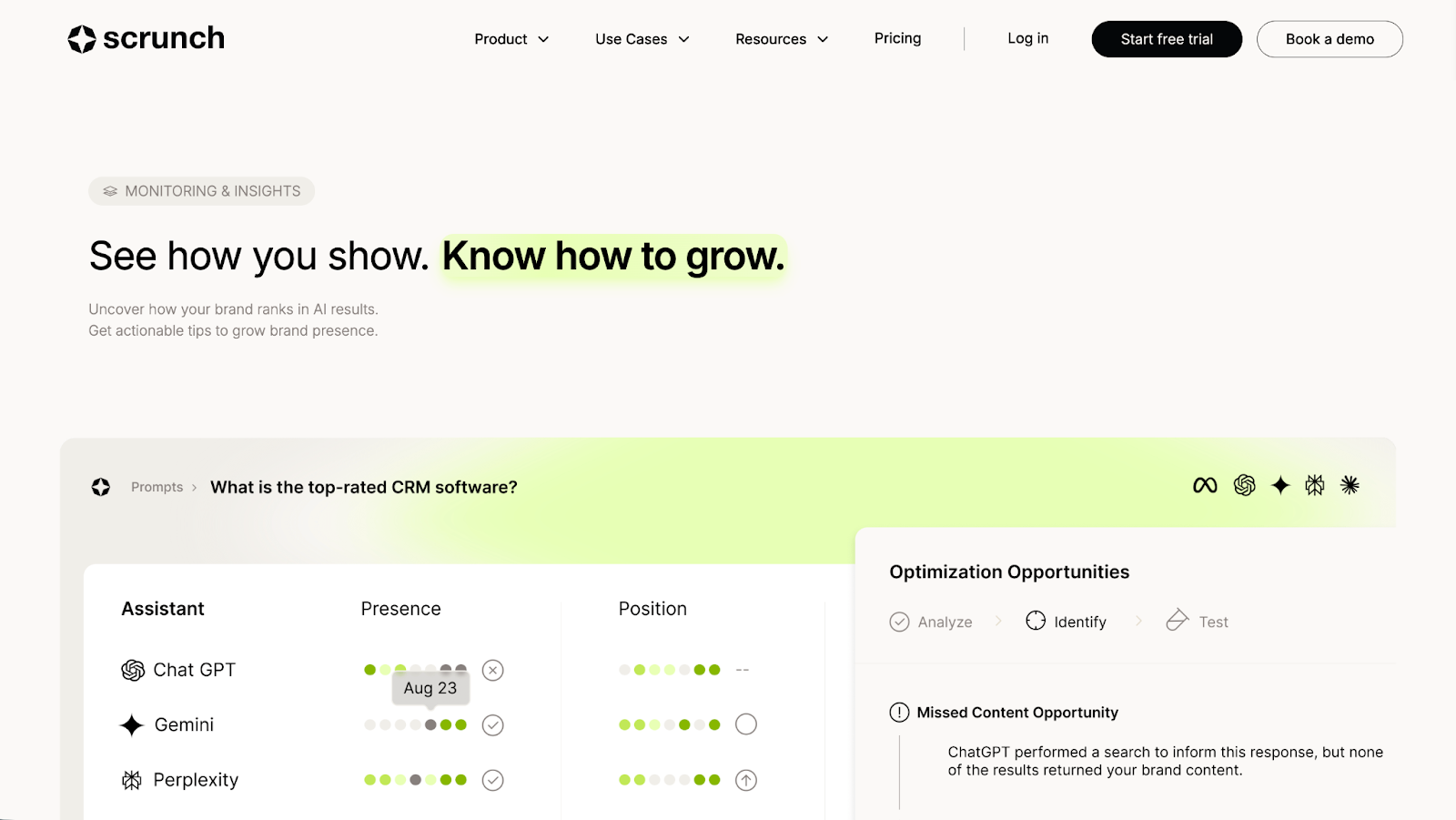
Scrunch structures its platform around three pillars: monitoring (prompt tracking, competitive intelligence, funnel analysis), analysis (site audits, sentiment, citations), and optimization (recommendations, content generation, and an Agent Experience Platform at Enterprise).
How it compares to Profound
Scrunch's Core plan ($250/mo) gives you four AI platforms — ChatGPT, Perplexity, Google AIO, and Copilot — with 125 prompts and 5 site audits per month. That's broader model coverage than Profound's $99 Starter (ChatGPT only) but narrower than Profound's $399 Growth (three engines plus content creation).
Scrunch has a few things Profound doesn't at the Core level: persona and language modeling (tracking AI responses across different user types and languages), funnel analysis (visibility across customer journey stages), and AI bot traffic tracking.
But Scrunch lacks Profound's Prompt Volumes feature (real-user query intelligence) and has no Shopping module for ecommerce. Content generation is listed but limited compared to Profound's 6 optimized articles per month at Growth.
Claude, Gemini, Meta AI, and Grok are Enterprise-only on Scrunch, same as Profound.
3. Semrush AI visibility toolkit
Best for
Teams already invested in Semrush that want unified SEO + AI tracking without adding another vendor.
Pricing
Starts at $199/mo (Starter), $299/mo (Pro+), $549/mo (Advanced). Annual billing at ~17% discount.
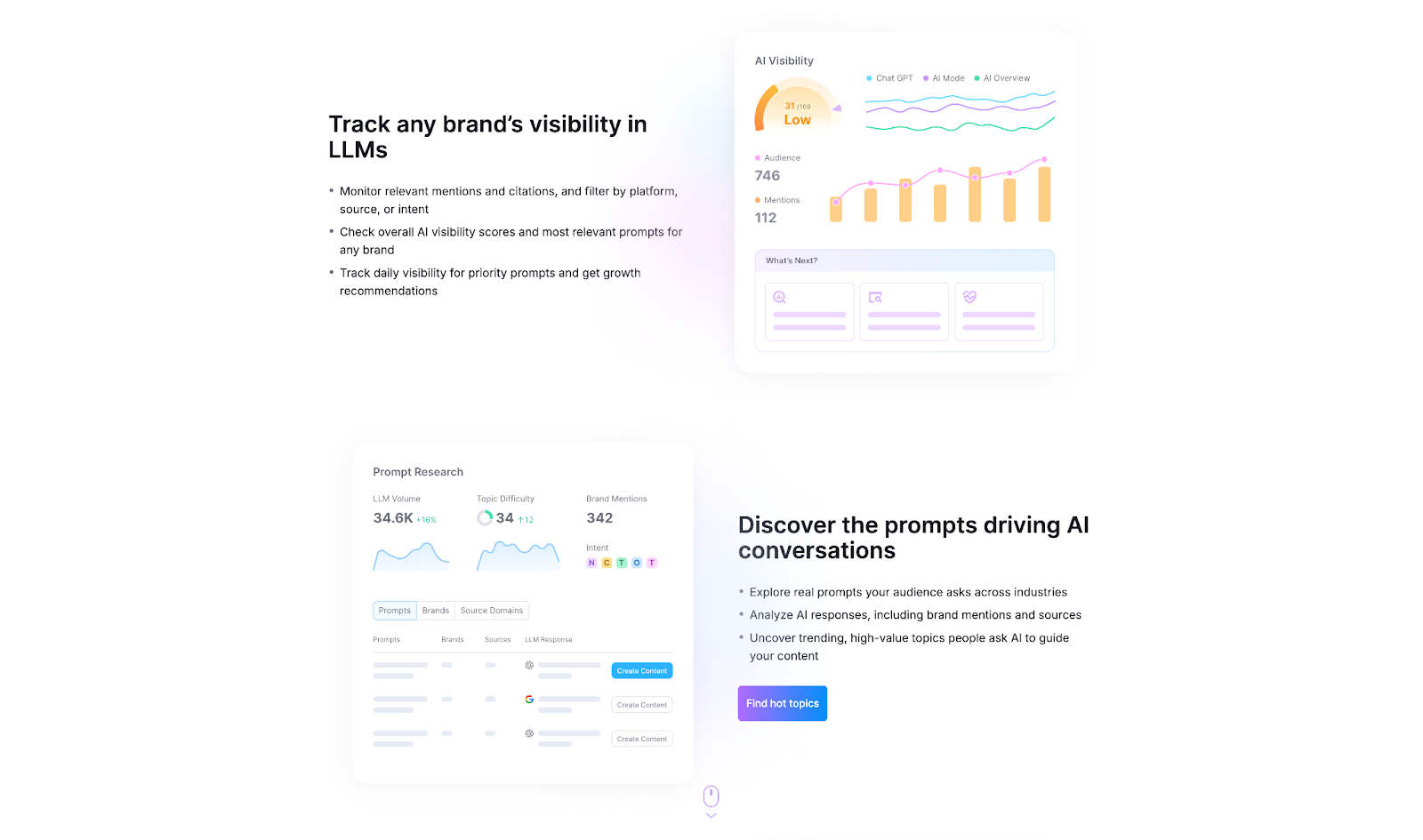
Semrush's AI Visibility Toolkit is built directly into their Semrush One platform. Custom prompt tracking (50–200 prompts depending on tier), AI brand insights, AI-ready site audits, and competitor AI analysis — all alongside their traditional SEO infrastructure.
How it compares to Profound
Completely different value proposition. Profound is a standalone AEO platform. Semrush bundles AI visibility with a full SEO suite — keyword research, backlink analysis, rank tracking for thousands of keywords, site audits.
Semrush's Starter ($199/mo) gives you 50 custom prompts with daily AI rankings plus 500 keywords tracked daily. Profound's Growth ($399/mo) gives you 100 prompts across 3 engines plus 6 optimized articles per month — but zero traditional SEO tools.
If AI visibility is your only concern, Profound goes deeper. If you're managing both SEO and AI search, Semrush consolidates your stack.
4. Athena
Best for
Enterprise brands wanting strong optimization tools and specialized vertical solutions.
Pricing
Self-Serve at $95/mo (annual) or $295/mo (monthly). Enterprise is custom.
Athena tracks 8+ LLMs and brings some unique capabilities — the ACE (Athena Citation Engine) at Enterprise, a proprietary prompt volume estimation model, and specialized solutions for ecommerce (Shopify revenue attribution), agencies (Pitch Workspace), and PR (AI-optimized press kits with crisis detection).
How it compares to Profound
Athena's self-serve plan ($95/mo) is the same price as Profound's Starter but covers all major LLMs instead of just ChatGPT. That's a significant gap.
Both platforms offer prompt volume intelligence, though the approaches differ — Profound uses anonymized consumer panels, Athena uses a proprietary ML model (Enterprise only).
Athena's vertical specialization is stronger. The ecommerce Shopify integration with direct revenue attribution and the PR press kit tools don't have equivalents in Profound. Profound's Shopping module (Rufus, ChatGPT Shopping) addresses the ecommerce angle differently — at the product placement level rather than the revenue attribution level.
Case study numbers are strong: Rootly saw ~10x citation rate growth, Lago got a 50% increase in demos from AI search, and Grüns reported 6x Share of Voice lift in 60 days.
5. Otterly AI
Best for
Budget-conscious SMEs and agencies that need AI tracking without enterprise pricing.
Pricing
Lite at $29/mo, Standard at $189/mo, Premium at $489/mo. 15% annual discount. Free trial available.
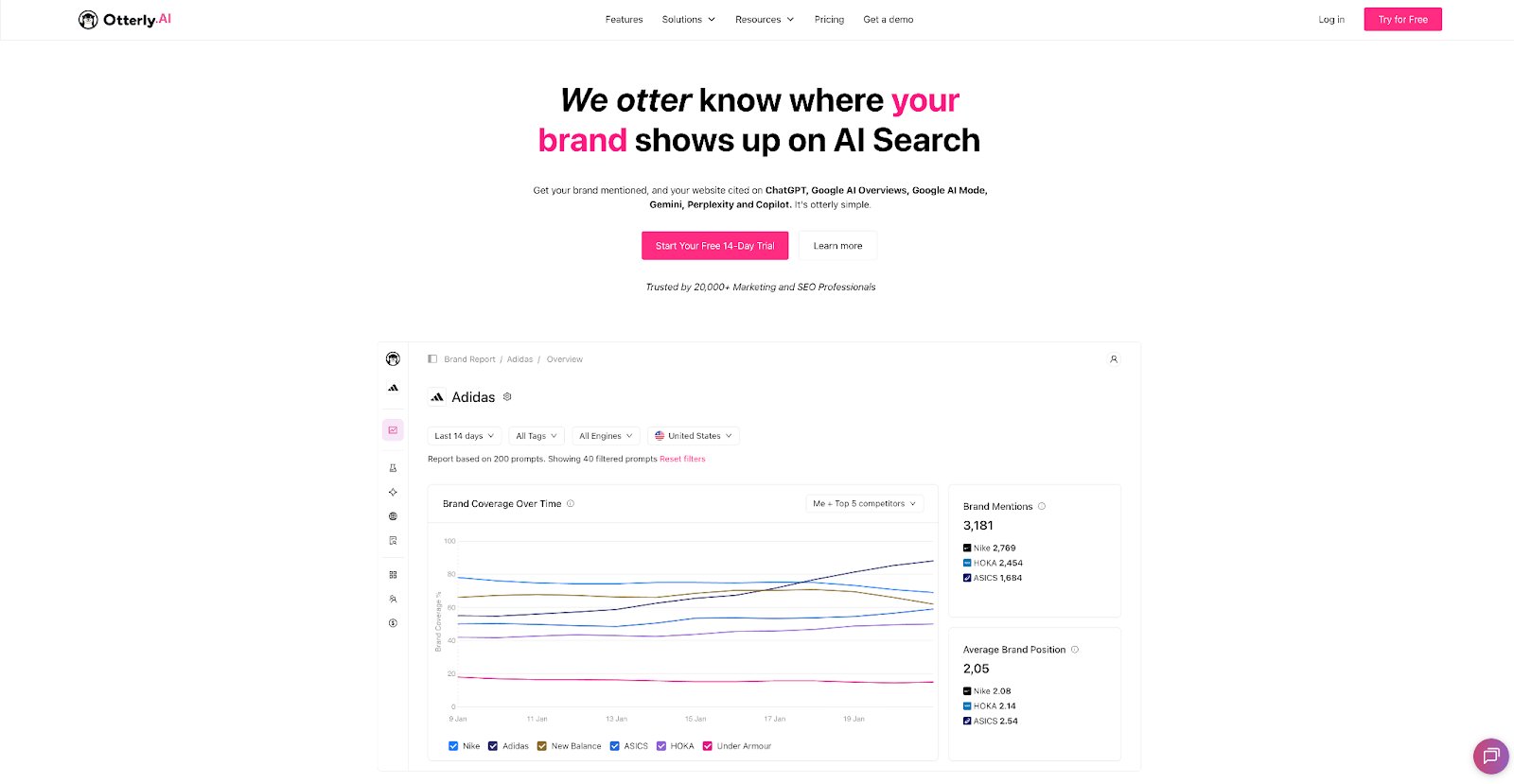
Otterly.AI is the most affordable entry point in this category. The Lite plan at $29/mo gets you 15 search prompts across ChatGPT, Google AI Overviews, Perplexity, and Copilot.
How it compares to Profound
Otterly's Standard plan ($189/mo, 100 prompts, 4 platforms) is less than half the price of Profound's Growth ($399/mo, 100 prompts, 3 engines). And Otterly includes Google Looker Studio integration and unlimited workspaces at that tier.
Otterly's Agency Partner Program offers increased prompt limits, pitch workspaces, white-label reporting, and centralized billing — Profound offers agency support too, but it's gated to Enterprise.
What Otterly lacks: Profound's Prompt Volumes feature, content creation tools, and Shopping module. Otterly is pure monitoring and analysis. Profound bundles more intelligence.
Recognized as a Gartner Cool Vendor 2025 (AI in Marketing) and G2 High Performer 2026 for Answer Engine Optimization.
6. Goodie AI
Best for
Teams that need AI shopping visibility (Amazon Rufus) and broad model coverage.
Pricing
Starter at $295/mo, Pro at $495/mo, Team and Enterprise are custom. All billed annually.
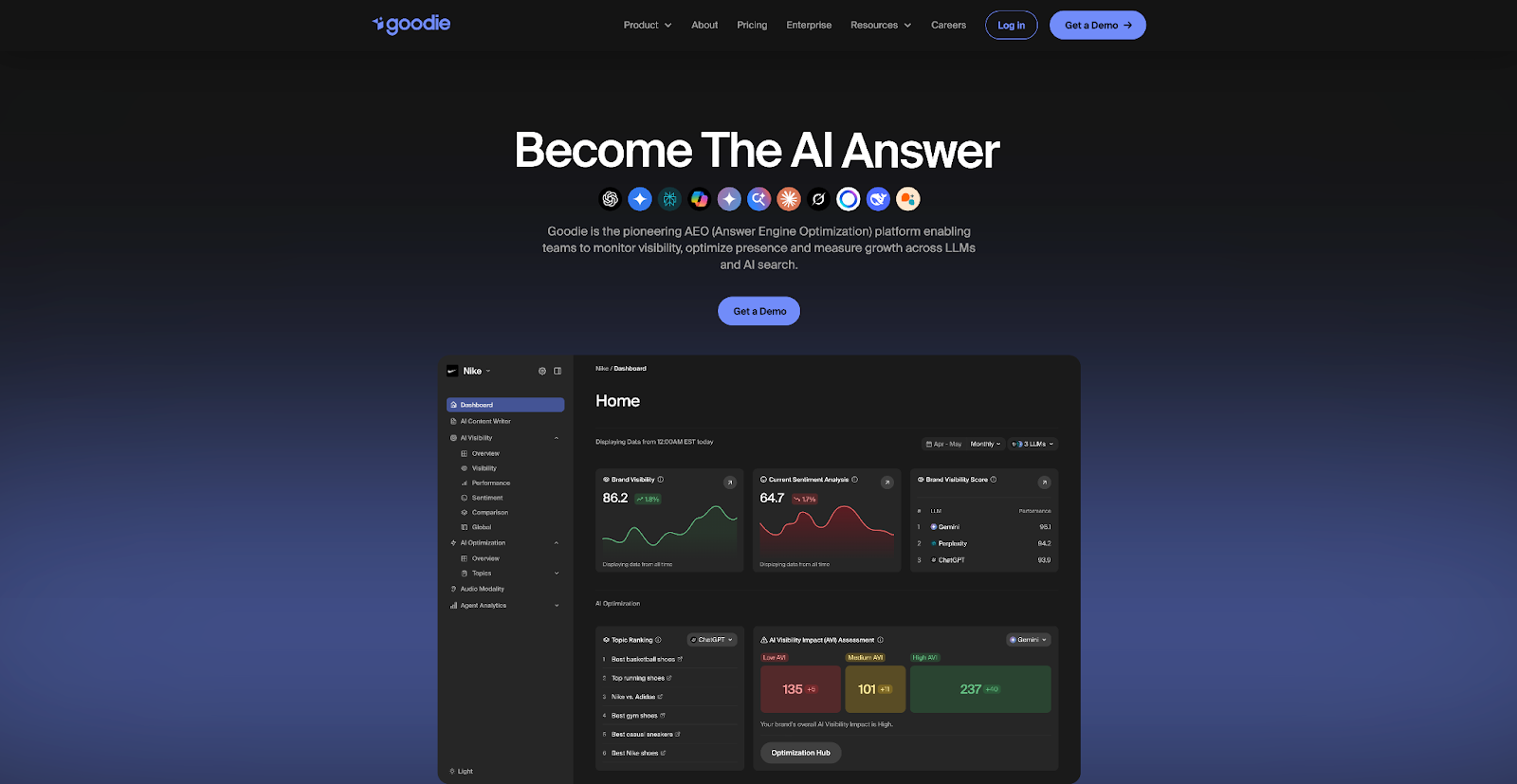
Goodie tracks a wide range of AI models. Core models available across plans include ChatGPT, Gemini, Meta AI, DeepSeek, Perplexity, Google AI Overviews, Copilot, and Brave AI Mode. Claude, Grok, and Amazon Rufus (AI Shopping Visibility) require higher tiers — Rufus is available from Team, while Claude and Grok are Enterprise-only.
How it compares to Profound
Both offer AI Shopping Visibility — Profound covers ChatGPT Shopping and Amazon Rufus, Goodie covers Rufus (Team tier and up). Both have agent/crawler analytics.
Goodie's Starter ($295/mo) includes 200 prompts with daily tracking across core models. Profound's Growth ($399/mo) gives you 100 prompts across 3 engines. On raw prompt-to-price ratio, Goodie is ahead.
Goodie adds "Agentic Actions" for AI-powered optimization and an AEO Content Writer. Profound's Create module offers content generation and optimization recommendations, so both address the content side.
The downside with Goodie: only 3 months of historical data on lower tiers, no data export until Team, and no API until Enterprise. Profound offers CSV and JSON exports starting at Growth.
7. LLM Pulse
Best for
Agencies and small teams wanting straightforward AI brand tracking with white-label options.
Pricing
Starter at €49/mo, Growth at €99/mo, Scale at €299/mo, custom Enterprise. 14-day free trial. Annual plans get 2 months free.
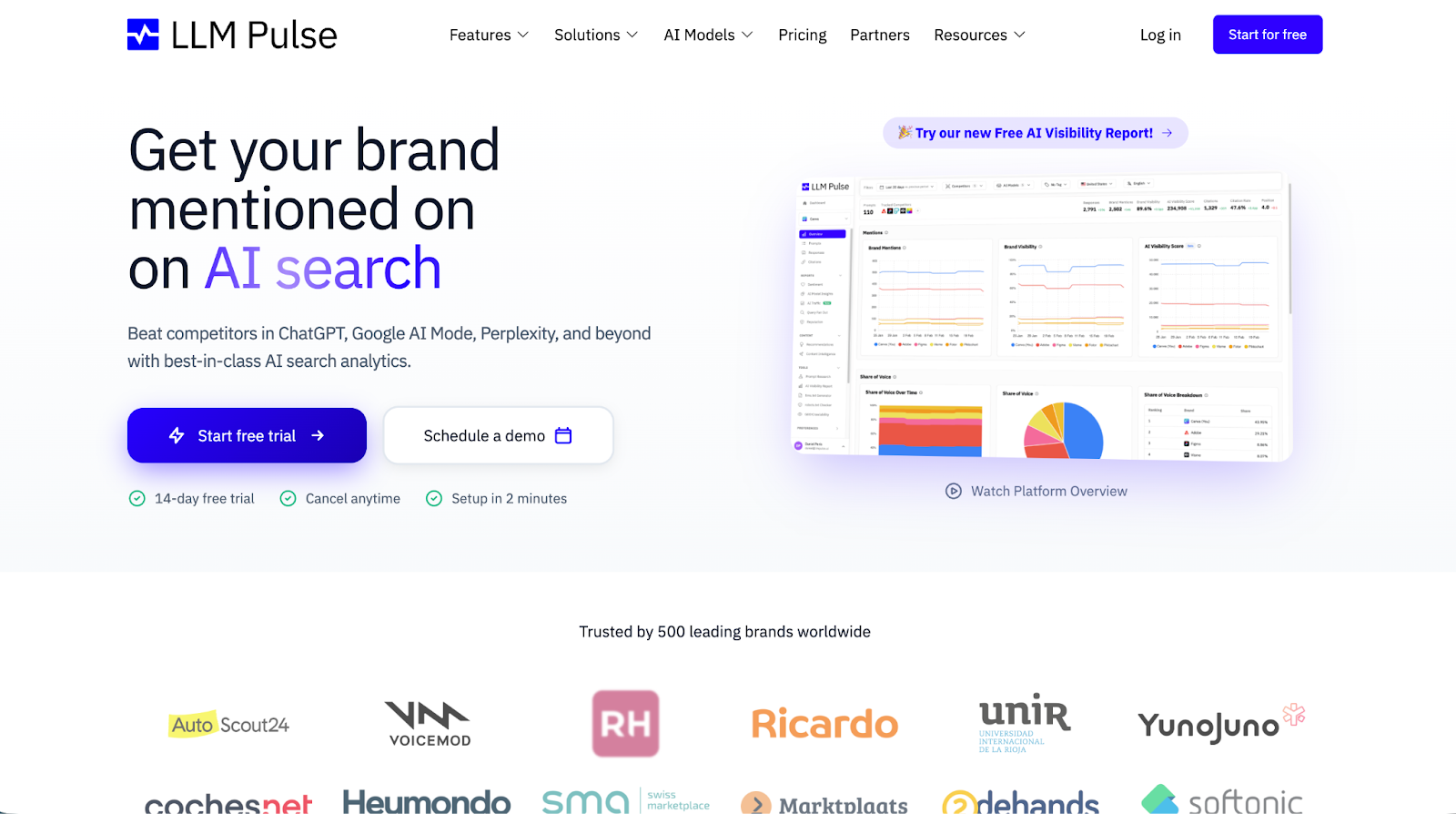
LLM Pulse keeps things clean. Track, Analyze, Optimize. It monitors 10+ AI models, provides visibility scores and citation analysis, and gives AI-powered content recommendations.
How it compares to Profound
LLM Pulse's Growth plan (€99/mo, 100 prompts) costs roughly a quarter of Profound's Growth ($399/mo, 100 prompts). You get sentiment analysis, traffic analytics, CSV/Excel exports, and 10 competitors per project at that level.
For agencies, LLM Pulse offers white labeling and volume pricing at Enterprise — Profound doesn't mention white-label capabilities.
The Scale plan (€299/mo) adds Looker Studio integration, MCP support, and API access with 300 prompts across 5 projects. Still cheaper than Profound's Growth with significantly more infrastructure.
Main limitation: weekly tracking frequency on all plans except Enterprise. Profound updates weekly too, so that's comparable.
8. Peec AI
Best for
Small marketing teams that want streamlined AI visibility tracking with no per-country fees.
Pricing
Starter at €89/mo, Pro at €199/mo, custom Enterprise. 15% annual discount.
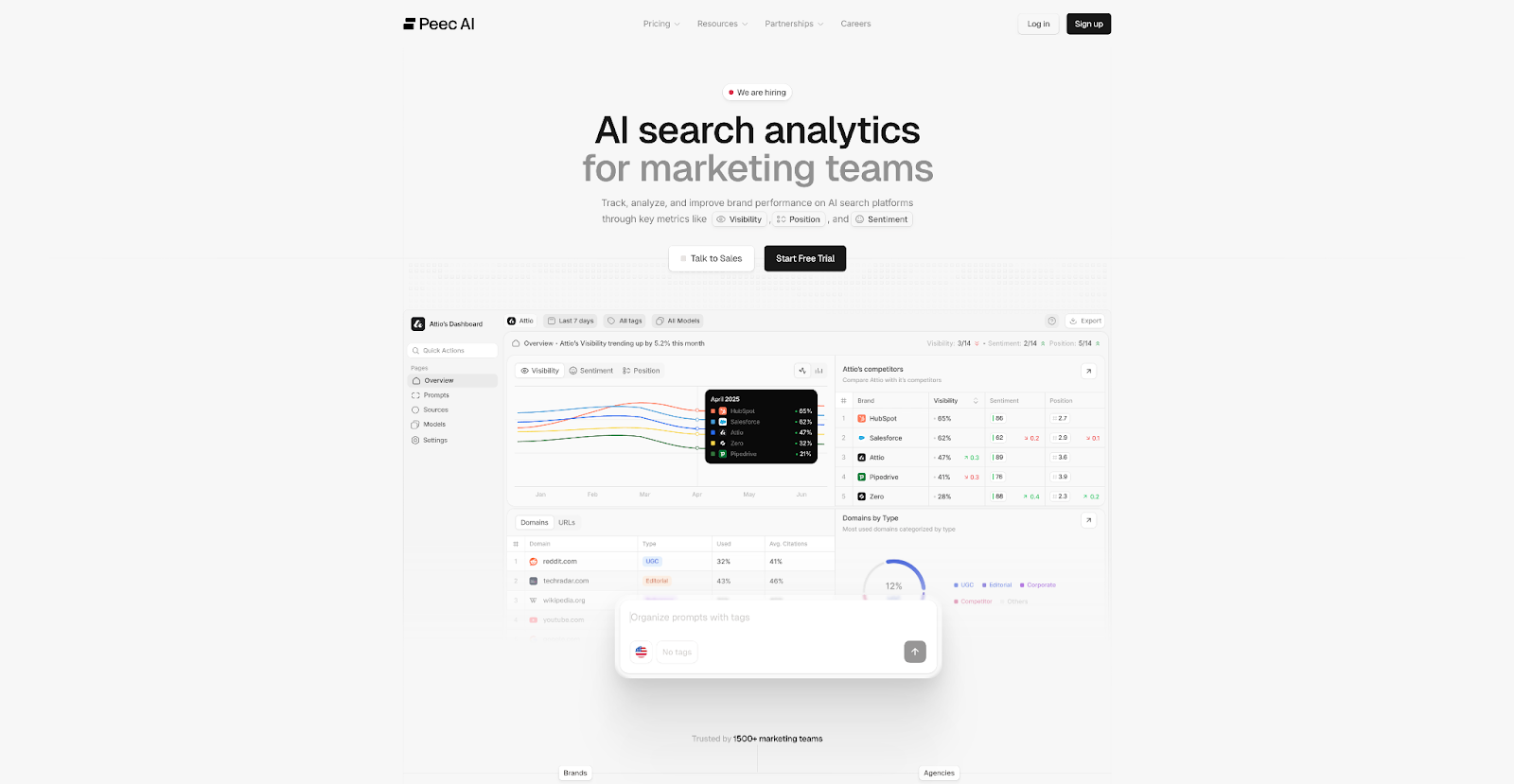
Berlin-based Peec AI has raised $29M and serves 1,500+ marketing teams. The platform focuses on simplicity — prompt tracking, daily automated monitoring, and historical analysis across ChatGPT, Perplexity, Google AI Overviews, and DeepSeek.
How it compares to Profound
Peec's Pro plan (€199/mo, 100 prompts, unlimited countries and languages) runs at roughly half of Profound's Growth ($399/mo, 100 prompts). Profound doesn't charge by region either, but its global coverage is listed as 10 specific countries. Peec is unlimited.
The billing model differs — Peec charges by "AI Answers" (prompts × models × days), up to 9,000 per month at Pro. Profound counts prompts directly.
Peec covers 4 base models (ChatGPT, Perplexity, AIO, DeepSeek) vs. Profound's 3 at Growth. Both offer Claude and Gemini at Enterprise only.
What Peec lacks: Profound's Prompt Volumes, Shopping module, and content creation tools. Peec is monitoring-focused.
Has a dedicated Agency Partner Program with pitch workspaces and centralized billing.
9. Writesonic
Best for
Content-first teams that want AI visibility tracking inside a full content creation and SEO suite.
Pricing
Lite at $49/mo ($39 annual), Standard at $99/mo ($79 annual), Professional at $249/mo ($199 annual), Advanced at $499/mo ($399 annual), custom Enterprise. 20% annual discount.
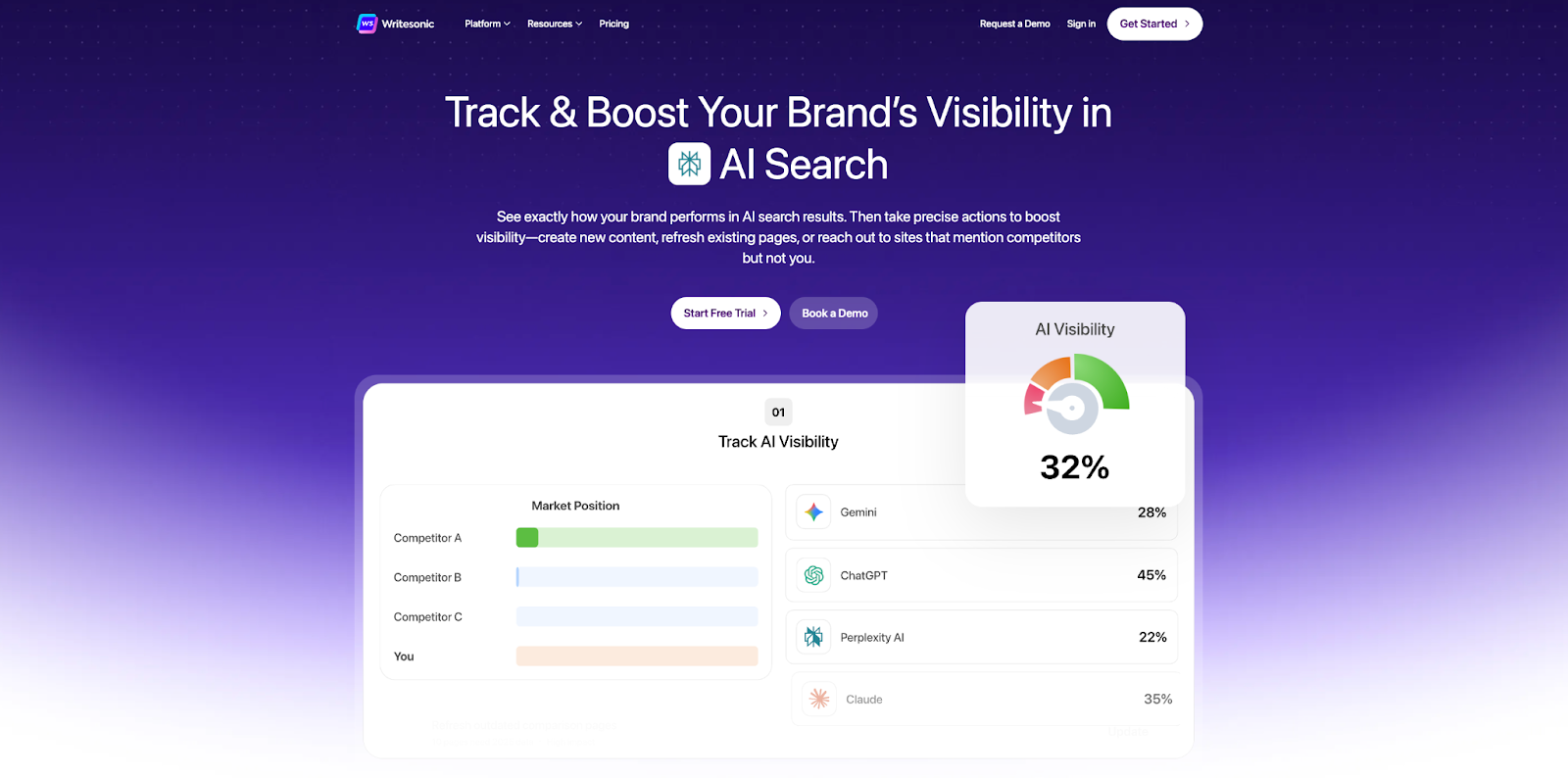
Writesonic bundles AI search tracking, SEO research, AI content writing, content optimization, and site audits into one platform. It positions itself as a replacement for your entire marketing stack.
How it compares to Profound
Writesonic's Professional ($249/mo, or $199/mo annual) includes GEO tracking, sentiment analysis, an action center with citation opportunities, 100 AI articles per month, and site audits. Profound's Growth ($399/mo) gives you 100 prompts, 3 engines, and 6 articles per month.
Even at monthly billing, Writesonic is cheaper with significantly more content production capacity. It tracks ChatGPT, Perplexity, Google AI Overviews, Gemini, Claude, and Copilot — broader model coverage than Profound at Growth.
The trade-off: Profound's monitoring is likely more granular. Its front-end capture methodology, Prompt Volumes intelligence, and Shopping module are things Writesonic doesn't replicate. But for teams where content creation is the bottleneck, Writesonic covers more of the workflow at a lower price.
SOC 2 Type II certified, GDPR and HIPAA compliant.
10. SE Ranking
Best for
SEO teams adding AI prompt tracking to their existing workflow without switching platforms.
Pricing
Core at €87.20/mo, Growth at €188/mo, custom Enterprise. Annual billing with 20% savings. 14-day free trial.
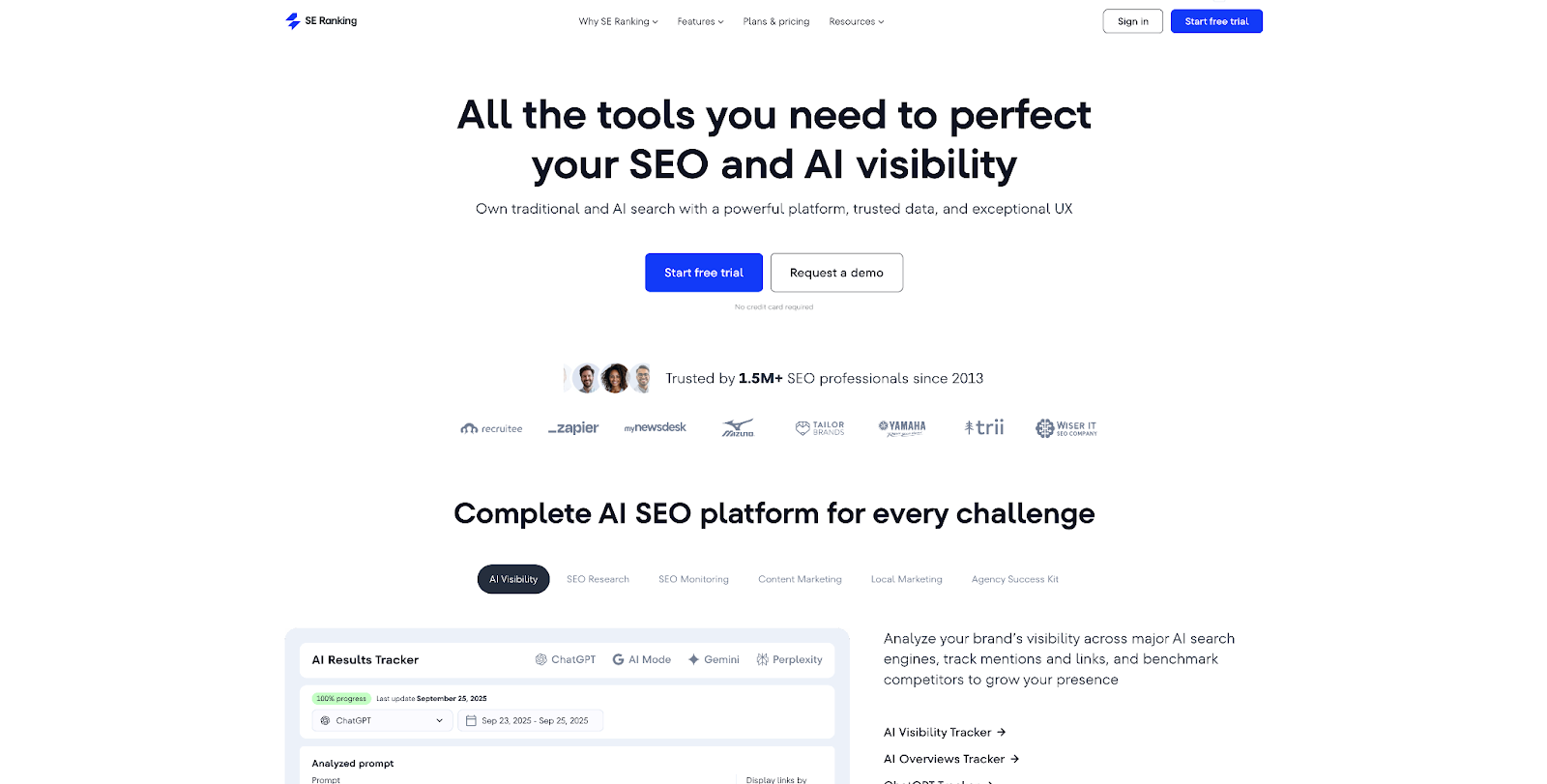
SE Ranking has evolved from a traditional SEO platform into a unified SEO + GEO tool. AI prompt tracking is integrated directly into standard plans.
How it compares to Profound
SE Ranking's Core plan (€87.20/mo) includes 100 AI prompts tracked daily, 2,000 keywords tracked daily, unlimited keyword/competitor/backlink research, and website audits (250K pages/mo). That's roughly a fifth of Profound's Growth price, with a massive traditional SEO toolkit thrown in.
Growth (€188/mo) bumps to 250 AI prompts daily across 15 GEO research domains with API access. Still half of Profound's Growth.
The catch: SE Ranking doesn't have Profound's front-end AI response capture, Prompt Volumes, Shopping module, or content creation tools. It's an SEO platform with AI tracking bolted on — not a dedicated AEO tool. But for teams managing both SEO and AI visibility, the value is hard to argue with.
11. Surfer SEO
Best for
Content teams that want AI visibility tracking paired with best-in-class content optimization.
Pricing
Standard at $99/mo, Pro at $182/mo, Peace of Mind at $299/mo. All billed yearly.
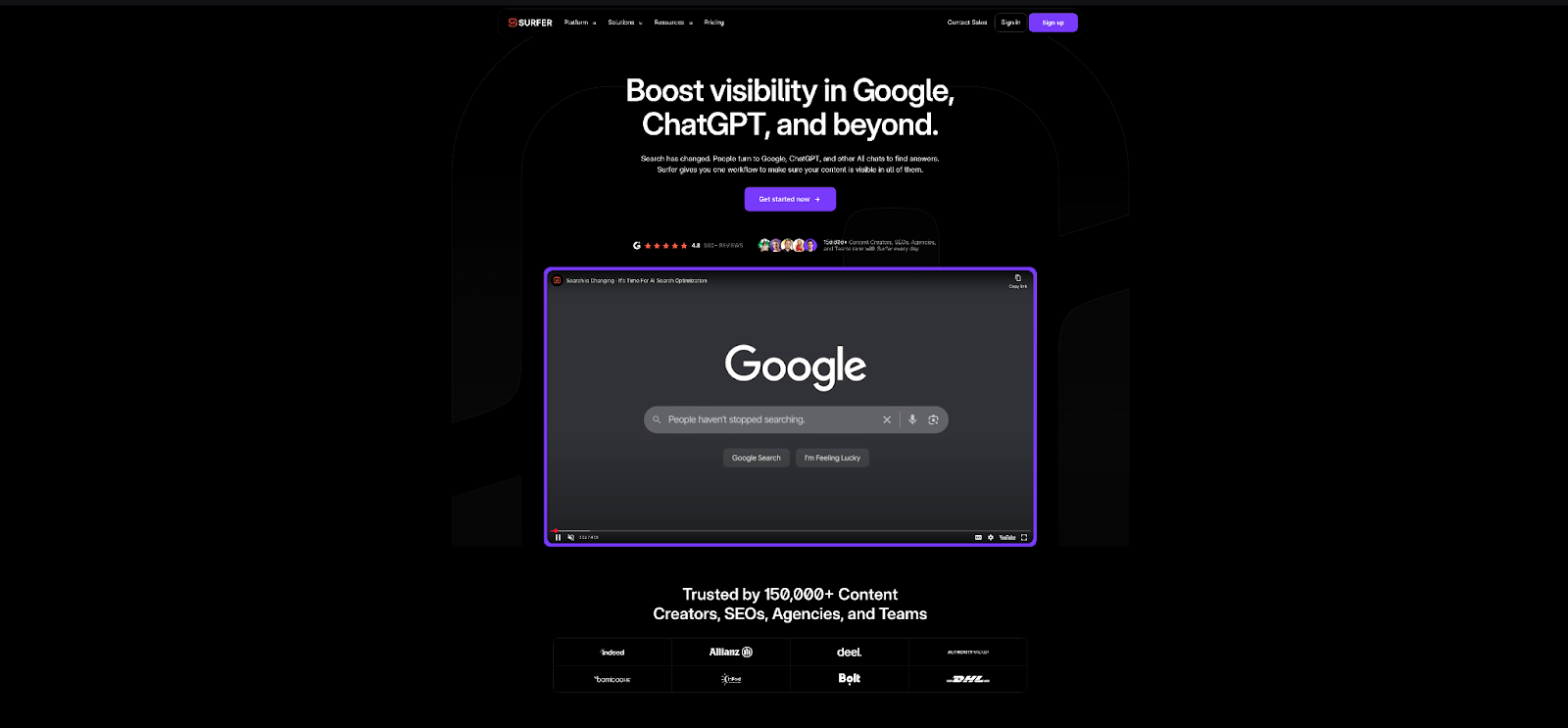
Surfer built its name on content optimization and has added AI prompt tracking and visibility monitoring to the mix.
How it compares to Profound
Surfer's Pro ($182/mo) includes 50 prompts refreshed daily with multi-engine AI visibility tracking, 5 brand workspaces, internal linking tools, and content gap analysis. Profound's Growth ($399/mo) offers 100 prompts, 3 engines, and 6 articles per month.
Surfer is cheaper and stronger on the content optimization side. Profound is deeper on monitoring intelligence — Prompt Volumes, Shopping visibility, and front-end response capture aren't things Surfer offers.
If your primary challenge is creating content that gets cited by AI, Surfer might be the better investment. If you need dedicated AI monitoring with unique data sources, Profound goes further.
12. AirOps
Best for
Teams that need AI-powered content automation and workflow infrastructure alongside visibility insights.
Pricing
Free Insights tier available. Solo, Pro, and Enterprise tiers. Free trial.
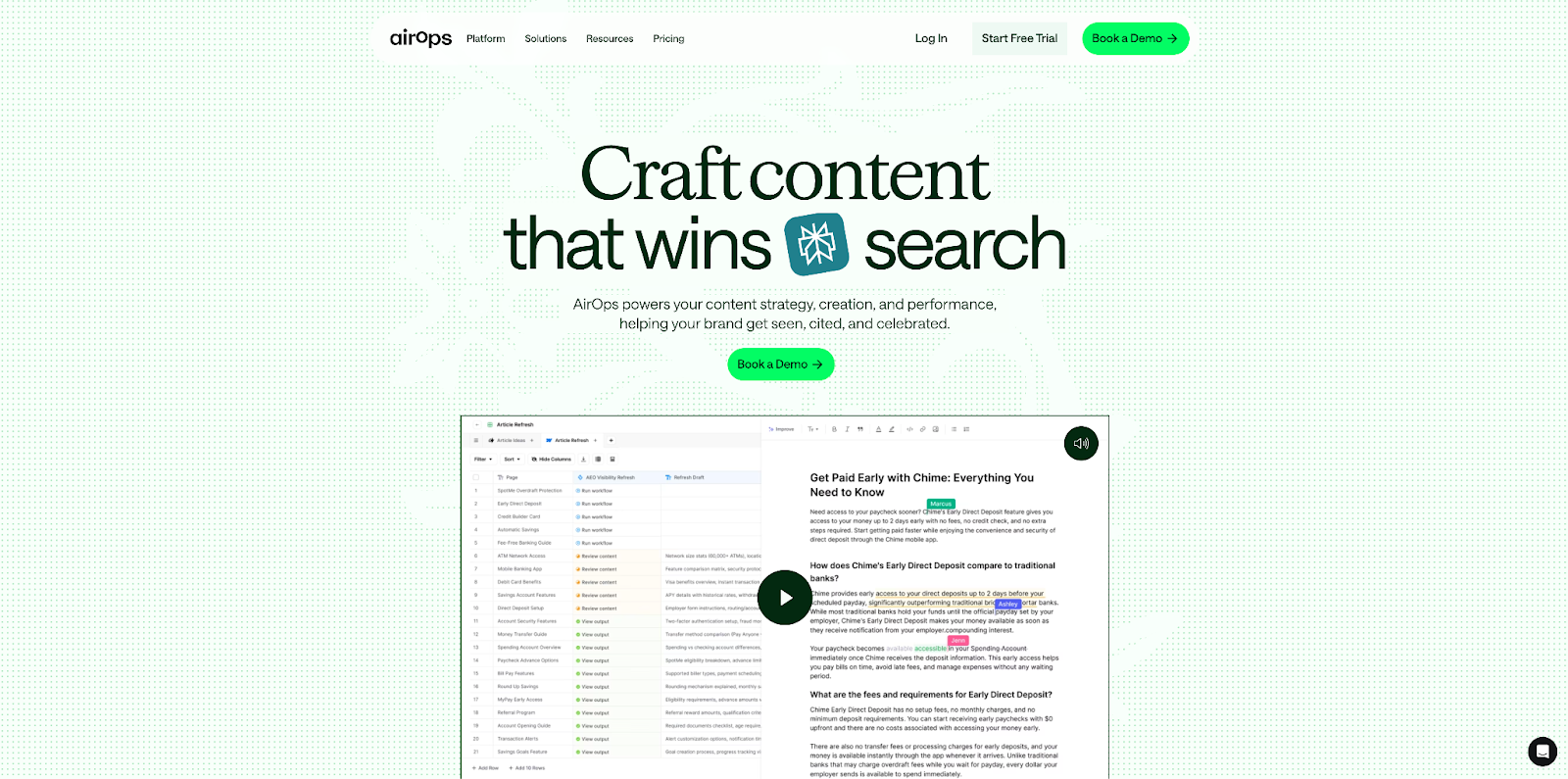
AirOps is less of a monitoring tool and more of an AI content operations platform. It combines visibility insights with automated workflows, grids, and knowledge bases — the "actions" layer most monitoring tools lack.
How it compares to Profound
Different products, adjacent problems. AirOps automates content creation and publishing at scale, with AI visibility insights on top. Profound is built around monitoring and intelligence.
AirOps' Pro plan includes multi-engine tracking (250 prompts/pages), weekly opportunity reports, and integrations with CMS platforms (WordPress, Webflow, Shopify), SEO tools (Ahrefs, Semrush, Moz), and project management tools (Asana, ClickUp).
Profound offers content creation through its Workflows module (6 articles/mo at Growth), but it's not the platform's core strength. AirOps makes content automation the center of gravity.
Webflow increased AI-attributed signups from 2% to over 10% in under a year using AirOps.
13. Clearscope
Best for
Content teams focused on optimization for both traditional search and AI discovery.
Pricing
Essentials at $129/mo, Business at $399/mo, custom Enterprise. Monthly billing, no contracts.
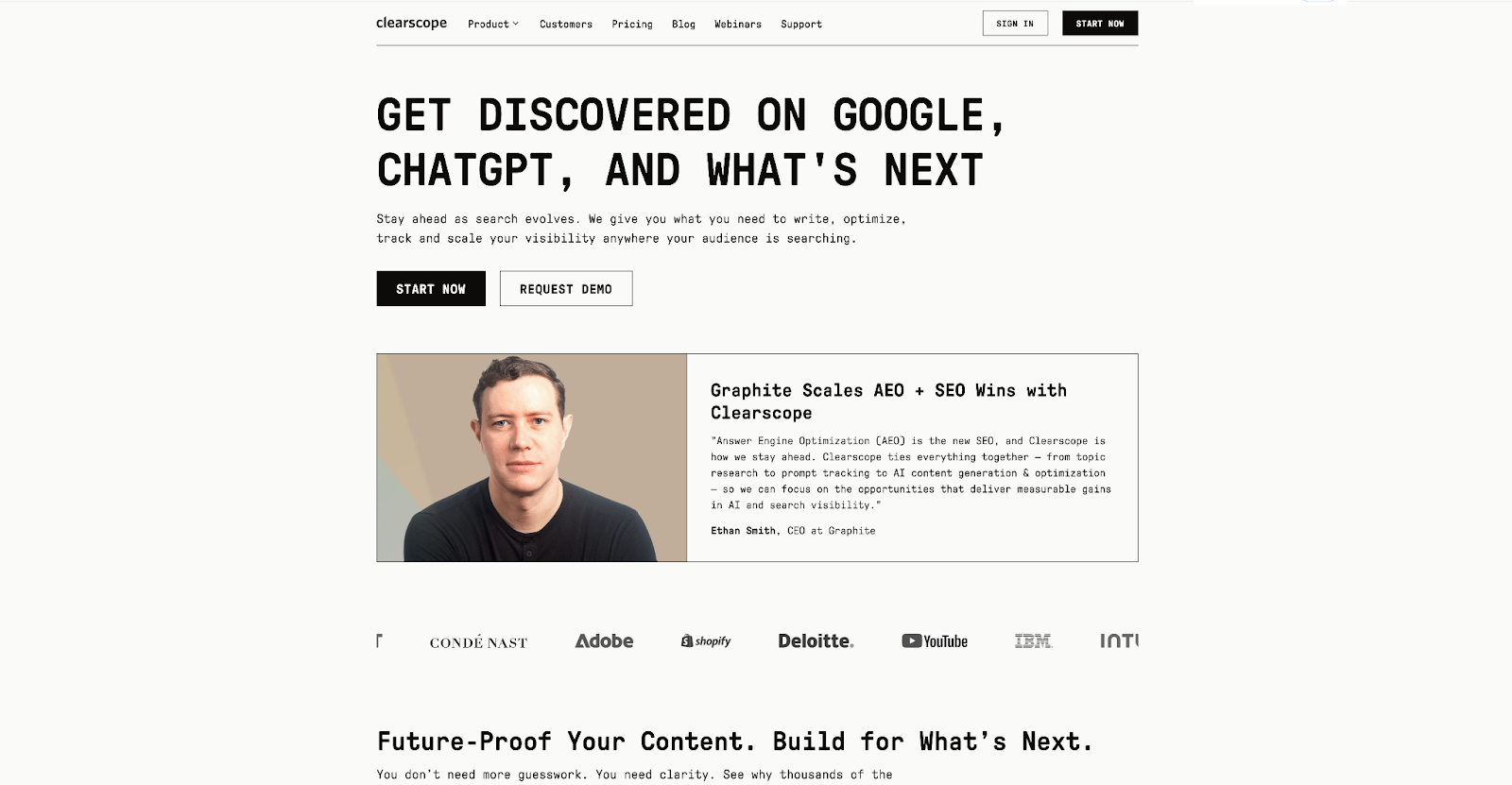
Clearscope started in content optimization and has expanded into AI visibility tracking. Every plan includes brand mention and citation tracking, search intent recommendations, and query fan-out awareness.
How it compares to Profound
Clearscope tracks 20–50 "AI Tracked Topics" depending on tier, rather than hundreds of individual prompts. It's a content optimization platform with AI visibility layered on, not a dedicated monitoring tool.
At $129/mo (Essentials), it's cheaper than Profound's Starter with unlimited users and projects. At $399/mo (Business), it matches Profound's Growth price and adds a dedicated account manager and 300 content inventory pages.
Clearscope doesn't have Prompt Volumes, Shopping tracking, or Agent Analytics. It's about making your content AI-friendly. Profound is about monitoring how AI already talks about you. Different tools for different problems.
14. Frase
Best for
Content teams that want AI visibility tracking built into their research-to-publish workflow.
Pricing
Starter at $39/mo, Professional at $103/mo, Scale at $239/mo. 20% annual discount. 7-day free trial.
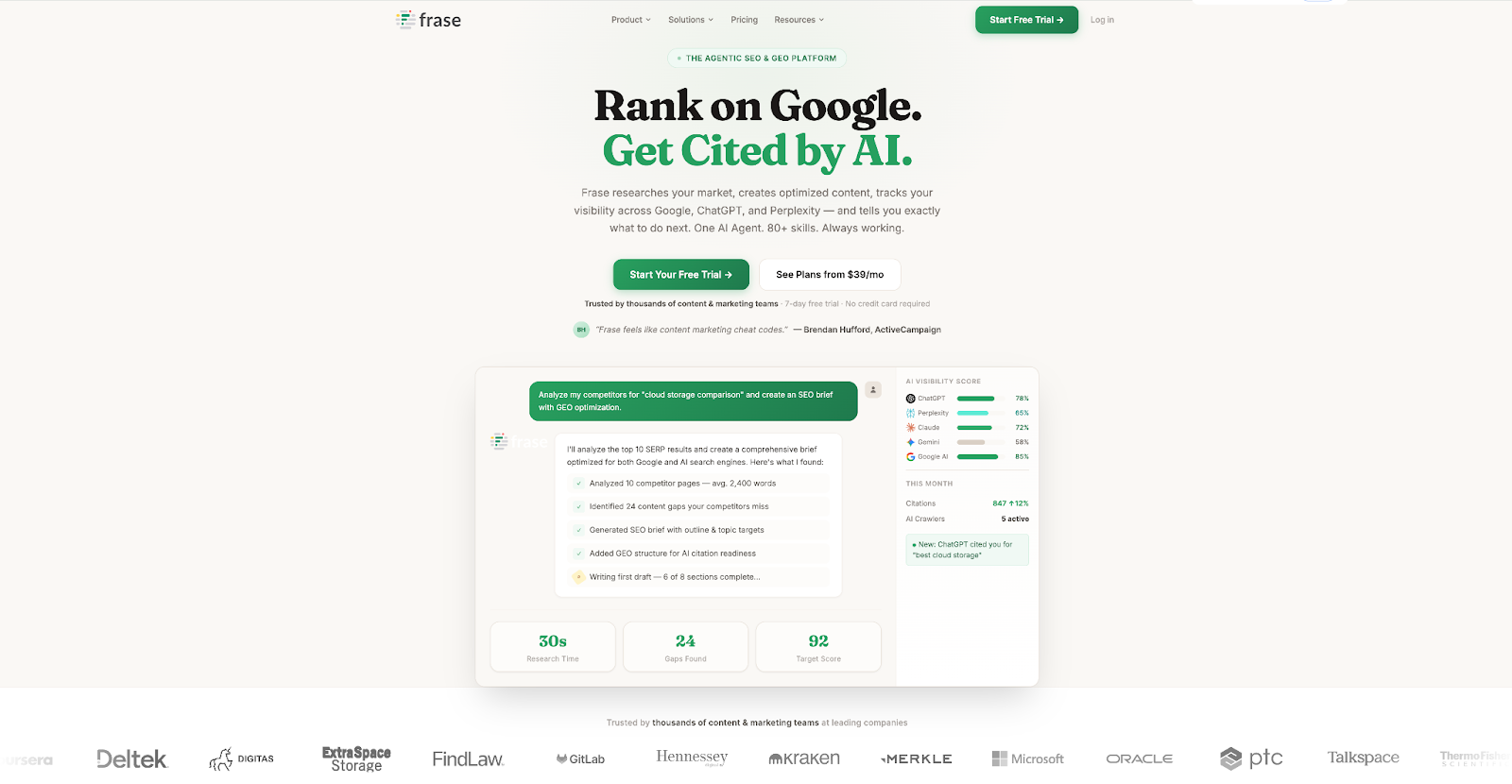
Frase covers the full content lifecycle — research, writing, optimization, publishing, and monitoring. AI visibility tracking is included across all plans, starting with 2 platforms and scaling to 8 at Enterprise.
How it compares to Profound
Frase's Professional ($103/mo) includes AI visibility tracking across 3 platforms, 40 AI-optimized articles per month, 250 audit pages, auto internal linking, and 5 brand voice profiles. That's roughly a quarter of Profound's Growth price with substantially more content production capacity.
Profound's Growth offers 100 tracked prompts and 6 articles per month — Frase's Professional offers fewer prompts but nearly 7x the article output.
Frase doesn't have Prompt Volumes, Shopping visibility, or Agent Analytics. But for teams where creating and optimizing content is the primary goal, Frase delivers significantly more per dollar.
Trusted by 50,000+ content teams including Microsoft, Oracle, and Coursera.
The bottom line
Profound earned its reputation by showing up early and building features others hadn't thought of yet. Prompt Volumes and Shopping visibility are real differentiators that most tools on this list don't match.
But the market has caught up on the basics. And at $399/mo for three engines with 100 prompts, the Growth plan is hard to justify when alternatives offer comparable or broader coverage for less.
If you want the deepest brand intelligence built on real search data with flexible filtering, Ahrefs Brand Radar is the strongest option — its 243M+ prompt database derived from actual PAA queries and third-party citation tracking put it in a different category on data quality alone.
If you need a full SEO + AI visibility stack, Ahrefs, Semrush or SE Ranking consolidate both for less than Profound charges for AI-only monitoring.
If you're on a tight budget, Otterly.AI or LLM Pulse get you started at a fraction of the cost with comparable platform coverage.
And if content creation is your bottleneck, Writesonic, Frase, or Surfer pair monitoring with production tools that help you act on the data — something Profound's 6-article-per-month limit barely scratches.
Pick the tool that matches the problem you're actually trying to solve. Not the one that got there first.
Till next time!