Best AI Visibility Trackers: Why Most Can't Answer the Questions That Actually Matter
Most AI visibility trackers do the same thing. Here's the architectural limitation they share — and the one tool built on a fundamentally different data model.
There's a question I keep running into when evaluating AI visibility tools, and none of the 47 I cataloged in a recent analysis can answer it properly:
What does AI think about a market I haven't told it to track yet?
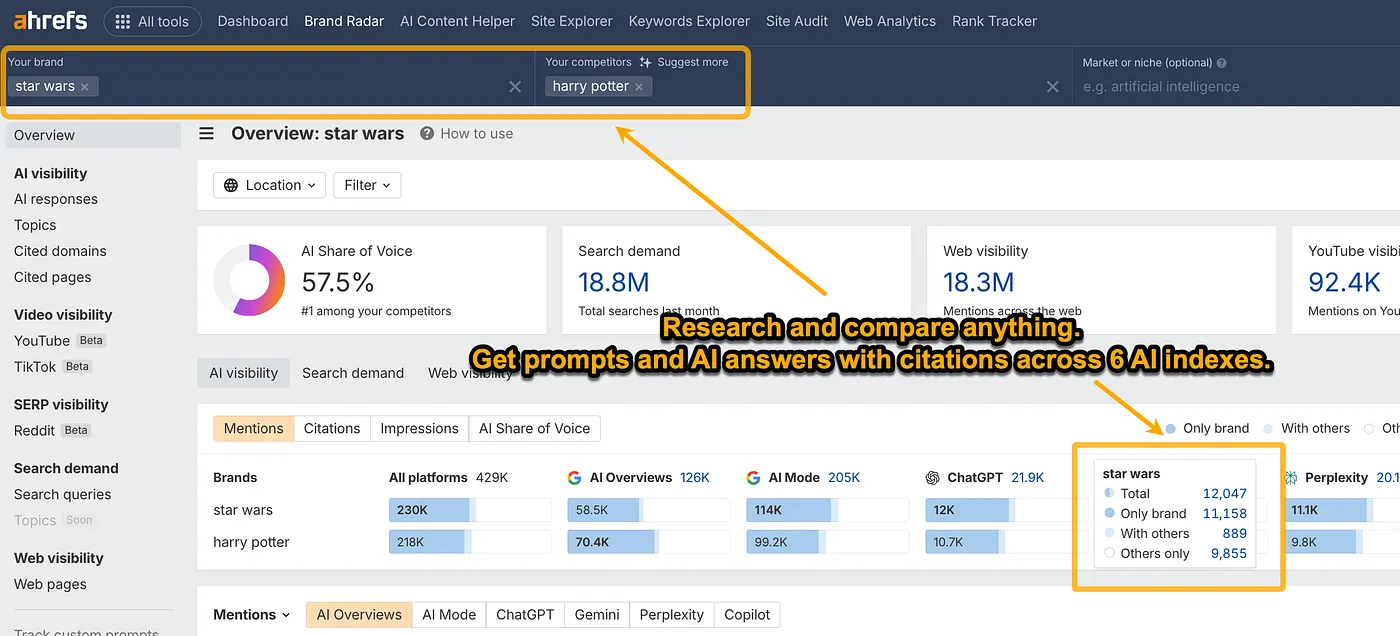
That sounds abstract, so here's what I mean concretely. Say you're an agency considering a pitch in the entertainment space. You want to understand how ChatGPT positions "Harry Potter" against "Star Wars" — not because either is your client, but because understanding how AI frames an entire category tells you where the opportunities sit before a campaign ever starts.
With most AI visibility tools, you can't do this. You'd need to set up a project, define custom prompts, wait for data to accumulate, and pay per tracked query. The tool monitors what you tell it to monitor. If you didn't predict the question in advance, you don't get the answer.
This is the kind of problem we set out to solve with Brand Radar — and I should be upfront that I work at Ahrefs and was closely involved in building it. What follows is naturally biased, but the architectural difference is real and I'll lay it out so you can evaluate it yourself.
Ahrefs Brand Radar works differently. You type in "Harry Potter" and "Star Wars," and you're immediately looking at 42 prompts where both were mentioned — filterable by dimension (book, movie, franchise), with the ability to isolate prompts mentioning one but not the other, or both simultaneously. No setup. No waiting. No per-entity charges.
The 100-prompt ceiling
Most AI visibility platforms operate on a prompt-tracking model. You select queries you want to monitor, the tool runs them against AI engines on a schedule, and you get a dashboard showing how your brand appeared over time. Plans typically cap this between 50 and 700 custom prompts depending on price tier.
This model answers one question well: "Is AI mentioning my brand for the queries I already identified?" It's useful, but it's inherently reactive. You only see what you thought to look for.
The structural limitation compounds at scale. Monitoring 100 prompts gives you a keyhole view of how AI represents your brand. It can't tell you what's happening across an entire product category, how competitors you haven't tracked are being positioned, or which prompt patterns are emerging in adjacent verticals. You're watching your lane, not the road.
243 million prompts vs. 100
Brand Radar's database currently contains 243M+ search-backed prompts indexed across six AI platforms: AI Overviews, AI Mode, ChatGPT, Perplexity, Gemini, and Copilot. The indexes keep growing.
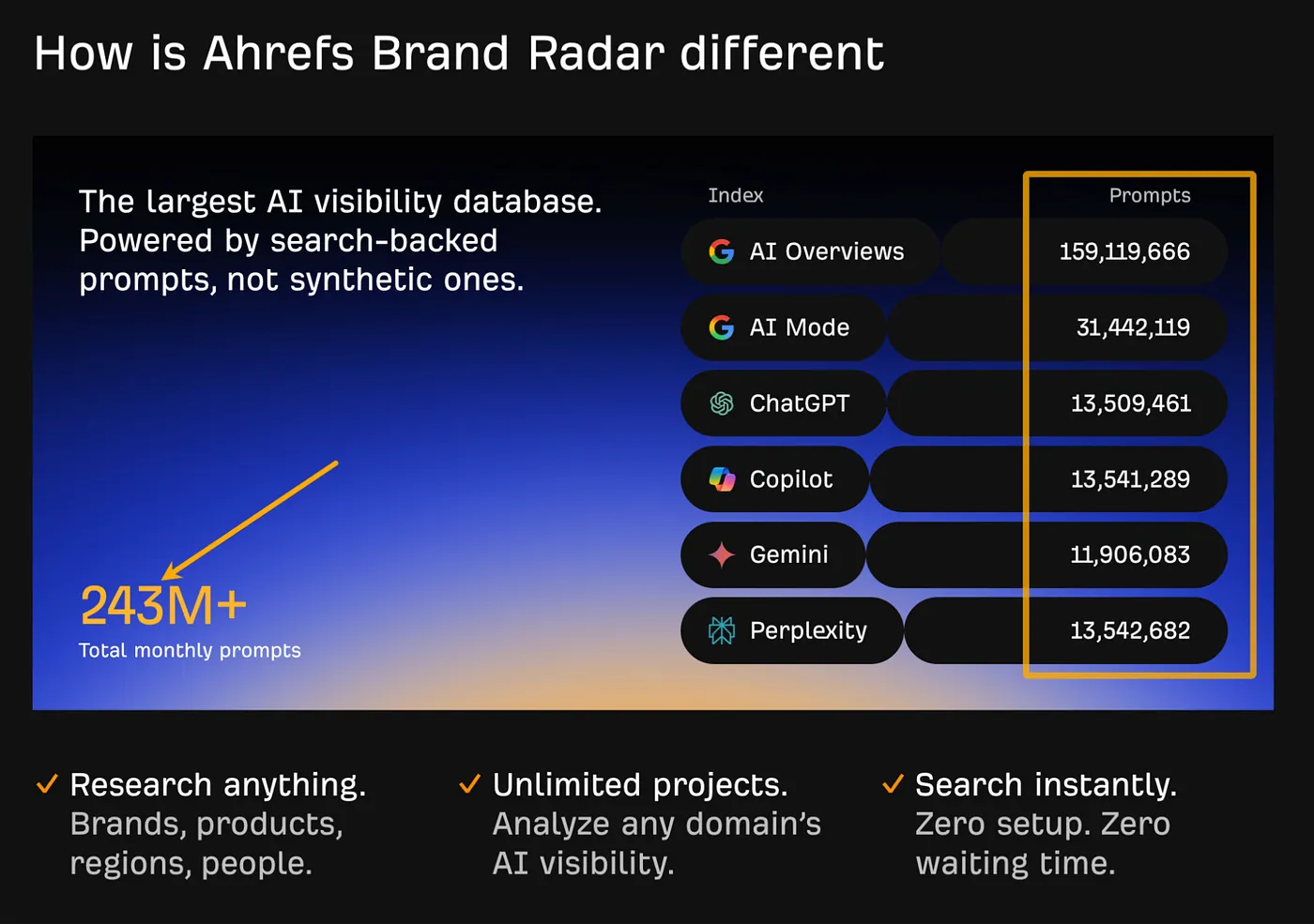
The prompts are derived from real search behavior — People Also Ask questions fed into AI platforms — not synthetic queries generated by the tool itself. When a competitor charges $300/month for 100 custom prompts, and Brand Radar is indexing 243M+, you're comparing a feature with a data infrastructure.
What Brand Radar measures
The platform tracks four core metrics:
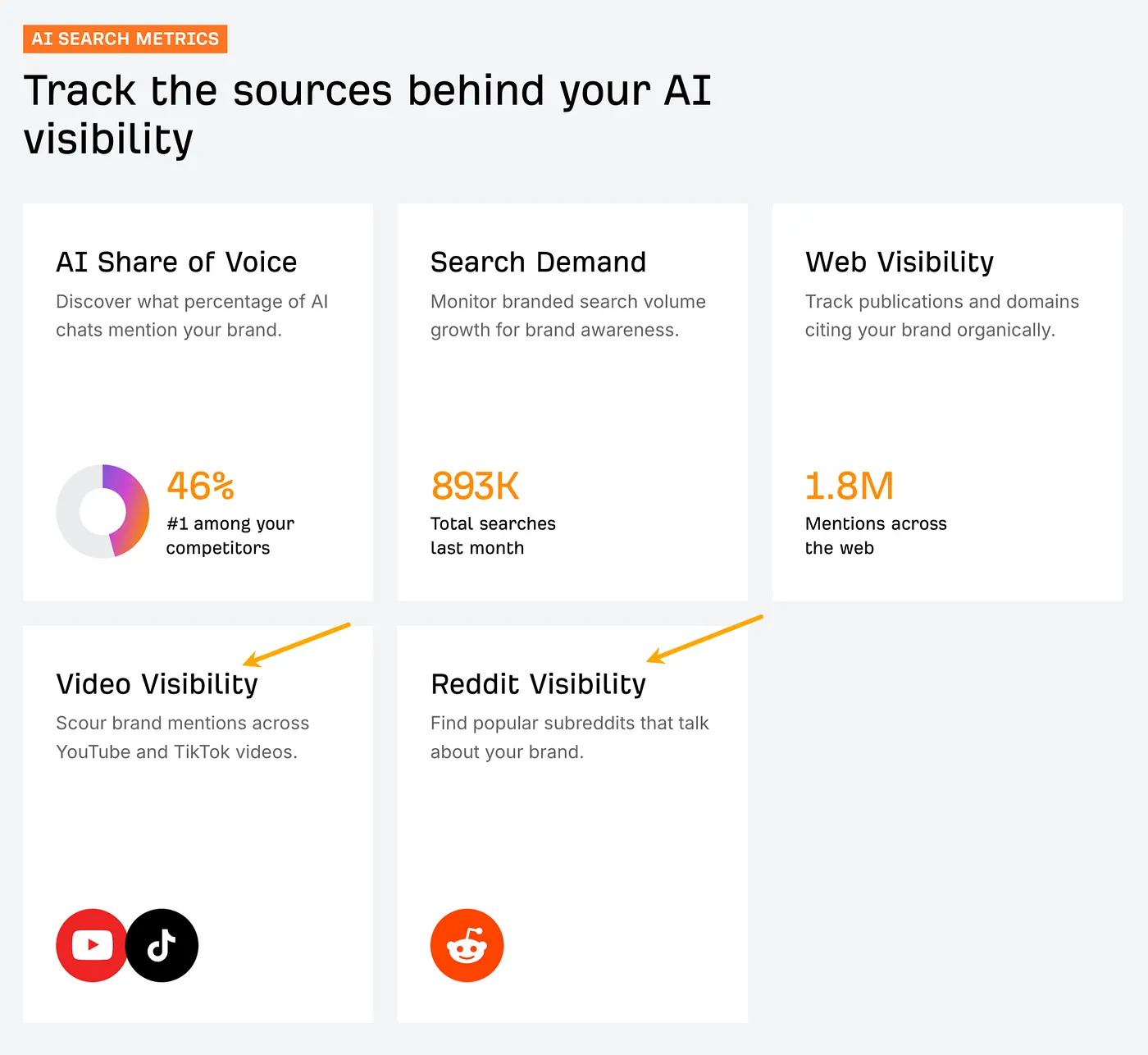
Mentions — how often your brand appears in AI responses. The broadest signal.
Citations — which specific websites AI links to when discussing your brand. If AI consistently cites a competitor's blog or a third-party review site instead of your own domain, that tells you exactly where influence sits.
Impressions — estimated exposure weighted by search volume. A mention triggered by a 50,000-volume query counts for more than one from a 200-volume query.
AI Share of Voice — your impressions as a percentage of total impressions across all brands in a query set. The competitive positioning number.
This is what enables the "track anything" capability. The data already exists for virtually any entity, category, or concept with search demand behind it. You're not setting up monitoring and waiting — you're querying a database that's already been built.
And if 243M+ prompts somehow aren't enough? Brand Radar also supports custom prompt tracking on top of the database — specific transactional queries, branded terms, niche competitive sets, whatever your business needs monitored over time. You get both layers: instant exploration across any entity, and ongoing tracking for the exact prompts that matter most.
The platform also indexes YouTube, Reddit, and TikTok visibility. AI models draw from these sources when constructing responses, and no other tool in the 47 I reviewed tracks them.
What this changes about the work
The prompt-tracking model produces brand monitoring. The database model produces market intelligence. The distinction reshapes what questions you can ask.
With a standard AI visibility tool, you can answer: "Is my brand mentioned in AI responses for these specific queries?"
With Brand Radar's architecture, you can answer:
- How does AI frame this entire product category, and which brands dominate which prompt types?
- Which third-party sources — review sites, Reddit threads, YouTube videos, industry publications — does AI cite most for this topic?
- Where are the citation gaps my competitors haven't filled?
- What content formats does AI prefer in this vertical — statistics posts, comparisons, expert guides, video content?
- How is AI positioning a competitor's product line that I haven't been tracking?
Every one of those questions can be answered instantly, for any entity, in any vertical. No project setup. No prompt allocation. No waiting for data to build up. By the way, Brand Radar operates independently of standard Ahrefs project limits, so you can analyze competitors, product categories, and entire industries without per-entity fees or project verification — ideal for agencies managing multiple clients and verticals.
For the full breakdown of what you can do with it, check the Brand Radar use cases guide.
Platforms like Profound, Peec, and Scruch were early to this space and helped establish what AI visibility tracking even looks like. If your primary need is watching how AI responds to a defined set of prompts about your brand, several of these tools will serve you.
But if the questions you need answered start with "what's happening in this market" rather than "what's happening with my brand" — that's where the architectural difference matters. Brand Radar is the only tool I found built for the second kind of question. Try it for free in Ahrefs Webmaster Tools.
Till next time!