GEO Tool Market Analysis: 47 Vendors, One Commodity, and The Data Problem
This is an analysis of all 47 generative engine optimization tools currently on the market — what they actually do, how they differ, and what the consolidation pattern tells us about which will survive.
What I found
There are 47 GEO tools on the market. Most buyers are choosing between them based on the wrong criteria.
The core mechanic — scheduled prompts, stored responses, dashboard — can be built by a single developer in weeks. That's why 47 competitors exist, why most feel interchangeable, and why roughly 80% will be gone within 3–5 years.
What actually separates them isn't features, pricing, or UI. It's where the data comes from. Most tools fabricate their own prompts. One — Ahrefs Brand Radar — derives its 243M+ prompts from observed search behavior. That's a structural advantage, and it compounds over time.
All 47 tools
Ahrefs Brand Radar, AIClicks, AirOps, Am I On AI, Amplitude, AthenaHQ, Atomic AGI, Bear, Botify, BrightEdge, ChatRank, Clearscope, Conductor, Evertune, Frase, Gauge, GEO Metrics, Geoptie, Goodie AI, Gumshoe AI, Keyword.com, Knowatoa, LightSite AI, LLM Pulse, Moz, Nightwatch, Obsero, Otterly AI, Peec AI, Profound, Promptmonitor, Quno.ai, Rankability, Rankscale, Scrunch, SE Ranking, Searchify, Seerly, Semrush AI Toolkit, seoClarity ArcAI, Surfer SEO, Ubersuggest, Writesonic, xFunnel, XOFU, XSeek, and ZipTie AI.
I didn't filter by size, funding, or market positioning. So, the list includes established SEO platforms with add-on GEO modules, pure-play monitoring startups, content platforms with AI visibility features, and at least one product analytics company that wandered into the space.
The synthetic data problem
This is the finding I keep coming back to, because it shapes how you should evaluate every tool on the list.
The majority of GEO platforms construct their own queries. They infer what users might ask an AI engine, fabricate those prompts, run them against ChatGPT or Perplexity, and report the results.
There's an efficiency argument for this — you can generate prompt volume without relying on external data sources — but the validity concern is real. The visibility scores you're seeing reflect how AI responds to questions that may never have been asked by an actual human.
The gap between "questions a tool guessed someone might ask" and "questions people actually ask" isn't academic. Synthetic prompts can overweight edge cases, miss high-volume conversational patterns, and produce benchmarks that look precise but don't correspond to real-world demand.
Ahrefs Brand Radar works differently. Its 243M+ prompts come from real search data — specifically "People Also Ask" questions with measurable search volume behind them. The prompts it tracks aren't hypothetical. They correspond to queries real people typed, which means the visibility scores, mention counts, and competitive benchmarks are anchored in actual behavior rather than simulated scenarios.
What Brand Radar actually measures
The platform monitors responses across six AI engines: ChatGPT, Perplexity, Gemini, Copilot, Google AI Overviews, and Google AI Mode. It also tracks YouTube, TikTok, and Reddit — because AI models pull from these when constructing answers.
Four core metrics
Mentions — the raw count of times a brand appears in AI responses. This is the broadest signal: how often does AI talk about you at all?
Citations — which specific websites AI references when discussing your brand. I'd argue this is the most strategically useful metric in the entire platform. If AI consistently cites a competitor's blog or a third-party review site instead of your own domain, that tells you exactly where influence sits and where you need to invest.
Impressions — estimated exposure weighted by search volume. A mention triggered by a query with 50,000 monthly searches counts for more than one triggered by a query with 200. This turns raw visibility into something closer to reach.
AI Share of Voice — your impressions as a percentage of total impressions across all brands in a query set. This is the competitive positioning number — one figure that answers "how much of the AI conversation in this category is ours?"
Where Brand Radar pulls ahead
Unrestricted entity analysis. Most competitors limit tracking to your own brand and charge per additional entity. Brand Radar lets you analyze any entity — competitor brands, product categories, topics, regional markets, entire industry segments — at no extra cost. Even something like "Start Wars vs Harry Potter".
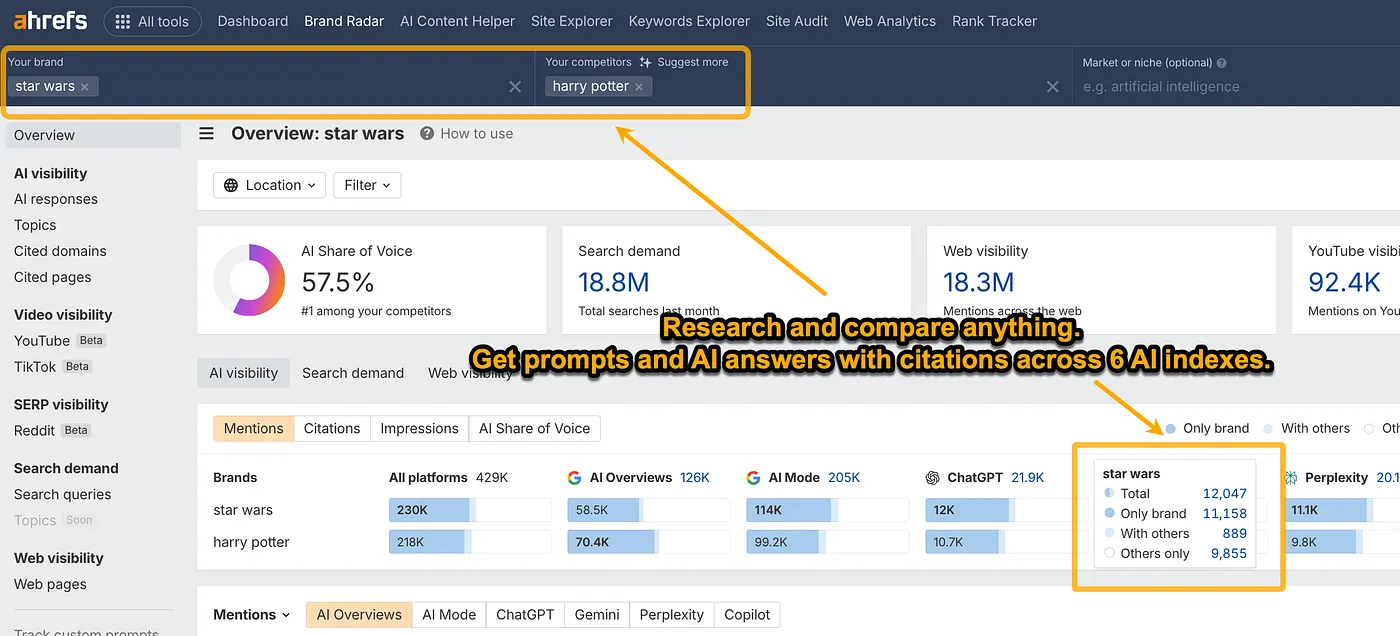
It operates independently of standard Ahrefs project limits, making it ideal for agencies analyzing multiple competitors and industries without being tied to specific website verifications.
You can track how a full product category performs in AI search, compare five competitor product lines side by side, or identify market-wide visibility shifts, all from one interface without per-entity fees.
Flexible query construction. Brand Radar exposes its 243M+ prompt database to user-defined queries. Build filters like "responses mentioning my brand but citing a competitor's site" (content authority gaps), "queries about [topic] where competitors get cited and I don't" (missed opportunities), or "all AI responses citing this specific URL" (page-level performance). Most GEO tools deliver fixed reports. This is a research instrument.
Third-party citation mapping. AI platforms frequently cite review sites, YouTube, Reddit, and industry blogs more than a brand's own domain. Brand Radar identifies exactly which external sources shape your AI reputation — directly actionable for PR targeting and partnership strategy.
Search demand history to 2015. Branded search volume tracked over a decade, plotted alongside AI visibility. Rising demand + rising AI Share of Voice = healthy pipeline. Flat demand + rising AI visibility = awareness without conversion. That's the ROI connection executives ask for, and no standalone GEO tool provides it.
"Brand Radar provides hands down one of the easiest and most comprehensive ways to understand what plays a role in AI answers: from brand and topics inclusions and gap analysis at scale, to easy citation identification for any topic, vertical in any model."
— Aleyda Solis, International SEO Consultant & Founder, Orainti
For the full breakdown of what you can do with it, check the Brand Radar use cases guide.
A note on data limitations
No GEO tool has access to real user prompts from ChatGPT, Perplexity, or Gemini. These platforms don't share prompt data. Clickstream offers limited visibility. Every vendor — Brand Radar included — works with proxies.
The difference is proxy quality. Most tools use self-generated synthetic prompts with undisclosed methodologies. Brand Radar derives its prompts from Ahrefs' 110B keyword database, including People Also Ask data — the closest available approximation to real search behavior, but still an approximation.
Ahrefs is unusually transparent about this. We acknowledge constraints the category operates under — query variance, personalization effects, model-level response differences — rather than leaning into "black box" mystique. In a market where most vendors avoid discussing what their data can't tell you, that candor is itself a differentiator.
Where this market is headed
47 tools. Same core mechanic. Most will be gone by 2028.
That doesn't mean they're all worthless. Tools like Profound, Otterly, and Peec were tracking AI visibility before most SEO companies admitted it mattered. Some serve niches Brand Radar doesn't prioritize — Profound's Amazon Rufus tracking, Scrunch's persona-based analysis, Goodie's agent experience optimization. Others like AirOps, Frase, and Writesonic bundle content creation workflows Brand Radar doesn't attempt.
But if you're evaluating this market right now, the decision framework is simpler than the vendor landscape suggests. Ask two questions: is the data real or synthetic, and does the tool connect AI visibility to something you can act on?
For teams already inside Ahrefs, Brand Radar is the natural next step. For everyone else, go ahead and try it free through Ahrefs Webmaster Tools.
Till next time!